Play Contract Rummy
Seven deals, seven contracts - Meet each one to lay down.How to Play Contract Rummy
In a nutshell: Seven deals, seven contracts - Meet each one to lay down. You play 2 players against the computer with 2 decks and 10-12 cards each, it's rated long-form, and the goal is simple: each deal demands a specific contract of sets and runs; meet it to lay down, then meld out.
Contract Rummy - also known as Liverpool Rummy, Progressive Rummy and Joker Rummy - stretches across seven deals, each with its own binding contract of sets and runs you must lay down before you can do anything else. The opening deal might demand two sets, the next a set and a run, building through two runs, three sets and mixed requirements all the way up to three runs in the final hand. A set is three or more cards of a rank, a run is four or more consecutive cards of one suit, and jokers stand in as wild cards to plug the gaps. Until you meet the exact contract for the current deal you cannot lay off a single card, so timing your first spread is everything. Played with two decks and jokers, it rewards planning several deals ahead and reshaping your hand to satisfy whatever the running contract demands.
Contract Rummy at a glance
| Goal | Each deal demands a specific contract of sets and runs; meet it to lay down, then meld out. |
|---|---|
| Players | 2 players (versus the computer here) |
| Cards dealt | 10-12 cards each |
| Decks used | 2 standard decks shuffled together |
| Difficulty | Long-form |
| Family | Melding |
Step by step
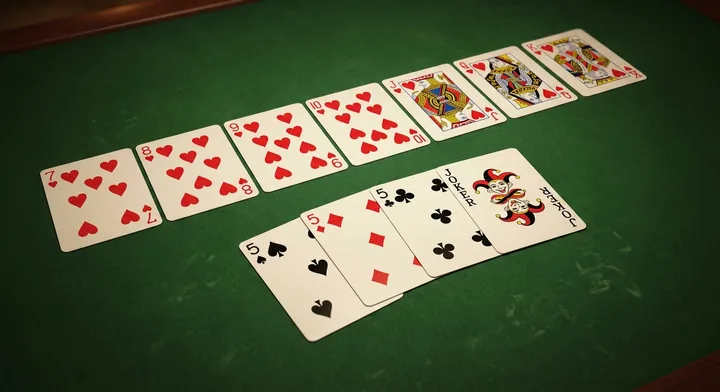
Goal
Meet the required contract of sets and runs for each of the seven deals, then meld out your remaining cards, finishing the match with the fewest penalty points overall.

Deal
Shuffle two decks together with the jokers. Deal ten cards each for the early hands and up to twelve for the later ones, turn one card face up to start the discard pile, and leave the rest as stock.
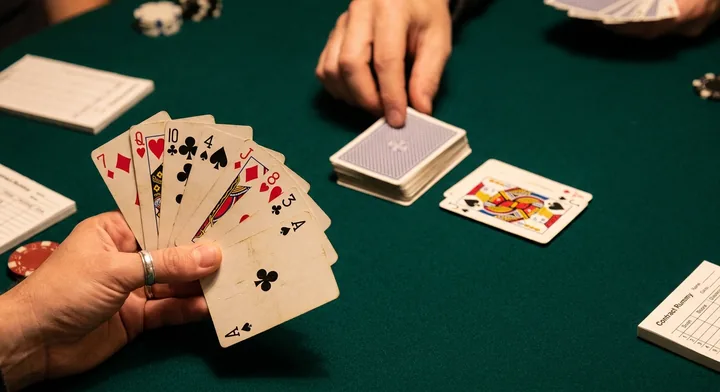
Draw and discard
Take the top card of the stock or the top discard, add it to your hand, then finish your turn by discarding one card. On the seventh deal players usually go out without a final discard.
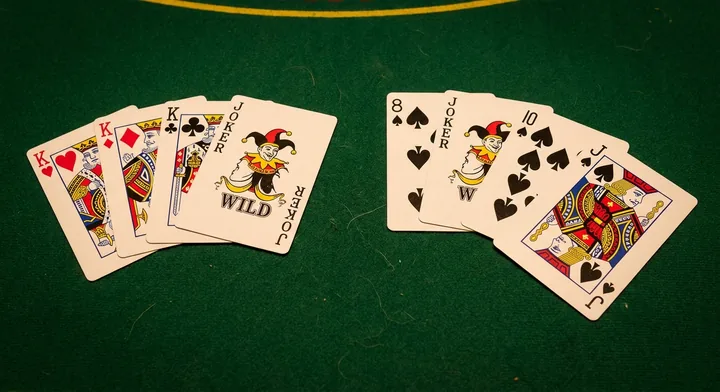
Melds
A set is three or more cards of the same rank and a run is four or more consecutive cards of one suit. Jokers are wild and can stand in for any card needed to complete a meld.

Winning
You may not lay down until you can meet that deal's exact contract, and you may not lay off cards until you have. Empty your hand to end the deal; the lowest total after all seven deals wins.
History of Contract Rummy
Contract Rummy emerged in the United States in the 1930s and 1940s as one of many elaborations on basic Rummy, borrowing the idea of set requirements from Contract Bridge, which was hugely popular at the time. Instead of letting players meld freely, it fixed a mandatory combination - a contract - for each successive deal.
The game spread under a cluster of names that all describe the same core idea. Liverpool Rummy, Progressive Rummy, Joker Rummy and Shanghai Rummy are close cousins, differing mainly in the exact contracts, the number of decks and small rules such as buying from the discard pile. The seven-deal progression from two sets up to three runs became the widely recognized standard.
Its appeal lies in the way the target keeps shifting: a hand that would win one deal is useless in the next, forcing constant adaptation. That escalating structure kept Contract Rummy a fixture of family card tables for decades and made it a natural ancestor of later contract-style melding games.
How to Win Contract Rummy: Strategy
💡 Top tip: Read the current contract first and build straight toward it - every card you keep should serve this deal's specific mix of sets and runs, not a generic rummy hand.
Winning tips, in order of importance
- Since runs need four cards while sets need only three, protect promising suited sequences early, as they are usually the slowest part of any contract to complete.
- Do not lay down the instant you can; a fraction of a turn later you can often add extra cards or a fresh joker and leave far less deadwood behind.
- Hold jokers for the pieces you genuinely cannot draw naturally, because a wild card wasted on an easy gap is a wild card missing from a hard one.
- Watch your opponent's discards to judge how close they are to their contract, and tighten up your throwaways as the danger of them going out rises.
- Remember the contract grows through the deals, so plan a couple of hands ahead and get comfortable holding a larger, more complex hand late in the match.
- Once you have laid your contract, lay off aggressively onto both players' melds to shed cards fast and cut the points left in your hand.
Advanced tactics for Contract Rummy
- Count how many of each rank and suit have appeared so you know whether a run is still alive or whether a joker is now your only realistic route to complete it.
- When a contract needs two runs or three runs, commit to your suits early, because switching suits midway through a deal usually wastes several turns you cannot spare.
- Where the rules allow it, plan to reclaim a joker later by replacing it with the natural card, freeing the wild to power a harder meld in the same deal.
- Weigh going out fast against going out clean - ending the deal with cards still stranded in your opponent's hand can outscore a hurried exit that leaves you deadwood.
- Treat the discard pile as information as much as a resource; picking the top discard tells your opponent exactly which meld you are assembling, so weigh the tell against the card.
- On the final three-run deal, sequence your draws so your last needed card is not the one you are forced to discard, and remember many rule sets bar a closing discard here.
- Keep a running feel for the match score, not just the deal, since a small penalty in an early hand matters far less than avoiding a big stranded hand in the later contracts.
Common Contract Rummy mistakes to avoid
- Ignoring the round's exact contract - each deal requires a set combination of sets and runs, so laying down anything else is not allowed.
- Melding too early to escape deadwood - once you lay down your contract you can be caught, so time it against your buys and hand size.
- Passing up buys you are entitled to - Contract Rummy lets you buy discards out of turn, and skipping a fitting card slows your contract badly.
- Buying recklessly for later rounds - every buy adds a stock card, so bloating your hand before a hard contract just piles on penalty points.
Contract Rummy Variations
Liverpool Rummy
A near-identical form and one of the game's common names, using the same seven contracts. Some versions add a buying rule that lets players claim a discard out of turn at the cost of an extra card.
Progressive Rummy
Emphasizes the escalating contracts by name and often runs deals of increasing hand size, so later contracts are met from a noticeably larger hand than the opening two-set deal.
Shanghai Rummy
A popular North American cousin that keeps the contract structure but formalizes buying from the discard pile, letting players take a shown card in exchange for drawing a penalty card from stock.
Kalooki
A Jamaican and British branch of the family, played with jokers as high-value wilds and its own point-scoring contracts, with popular fixed-target versions such as Kalooki 40 and Kalooki 51.
Joker Rummy
A name that stresses the wild jokers driving the game, sometimes allowing extra wilds or a rule to swap a natural card in for a melded joker so the wild can be reused elsewhere.
Contract Rummy FAQ
What is a contract in Contract Rummy?
A contract is the exact combination of sets and runs you must lay down in a given deal. There are seven deals, each with a fixed requirement, and you cannot meld at all until you can complete the whole contract.
What is the classic seven-deal progression?
The usual sequence is two sets, then one set and one run, then two runs, then three sets, then two sets and one run, then one set and two runs, and finally three runs on the seventh deal.
How long is a run compared with a set?
A set is three or more cards of the same rank, while a run must be four or more consecutive cards of a single suit. The longer run requirement is a defining feature of Contract Rummy.
Are jokers used?
Yes. The game is played with two decks plus jokers, and jokers are wild cards that can substitute for any card needed to fill out a set or a run.
Can I lay off cards before melding my contract?
No. You may not lay off cards onto any melds until you have first laid down your own complete contract for that deal. Meeting the contract unlocks laying off for the rest of the hand.
Why can there be no discard on the last deal?
The seventh deal is the three-run contract, and many rule sets let a player go out simply by melding their whole hand as they satisfy it, so no final discard is made when going out.
How is the winner decided?
Scores accumulate as penalty points for the cards left in hand at the end of each deal. After all seven deals the player with the lowest running total wins the match.
Why is it called Liverpool or Progressive Rummy?
Contract Rummy is known by several names, including Liverpool Rummy, Progressive Rummy and Joker Rummy. Progressive refers to the contracts growing harder each deal, and the other names are regional labels for the same family.
Contract Rummy guides & strategy
Still have a question about Contract Rummy? Browse the full rummy FAQ, look up a term like meld or deadwood in the rummy glossary, or compare Contract Rummy with the other games in the rules for every rummy game.
Last updated .