Play Indian Rummy
Thirteen cards, a pure sequence, and a race to declare.How to Play Indian Rummy
In a nutshell: Thirteen cards, a pure sequence, and a race to declare. You play 2 players against the computer with 2 decks and 13 cards each, it's rated popular worldwide, and the goal is simple: arrange all 13 cards into valid sequences and sets, including at least one pure sequence, then declare.
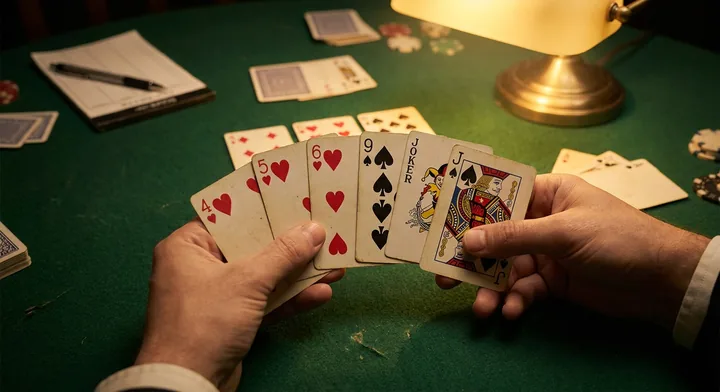
Indian Rummy, also called 13-card rummy or Paplu, is the melding game that dominates card tables across the subcontinent. Each player is dealt thirteen cards from two shuffled decks salted with printed jokers and a randomly cut wild-card joker, and the race is on to arrange every card into valid sequences and sets. The rule that gives the game its bite is the pure sequence: before any joker-assisted group counts, you must build at least one run with no wild card in it, and usually a second sequence besides. When your hand is fully grouped you declare by slipping a final card into the finish slot, and every opponent left holding unmatched cards pays their pip value. It is quick to learn, endlessly re-playable, and a fixture of festivals, family gatherings, and late-night online tables alike.
Indian Rummy at a glance
| Goal | Arrange all 13 cards into valid sequences and sets, including at least one pure sequence, then declare. |
|---|---|
| Players | 2 players (versus the computer here) |
| Cards dealt | 13 cards each |
| Decks used | 2 standard decks shuffled together |
| Difficulty | Popular worldwide |
| Family | 13-Card |
Step by step
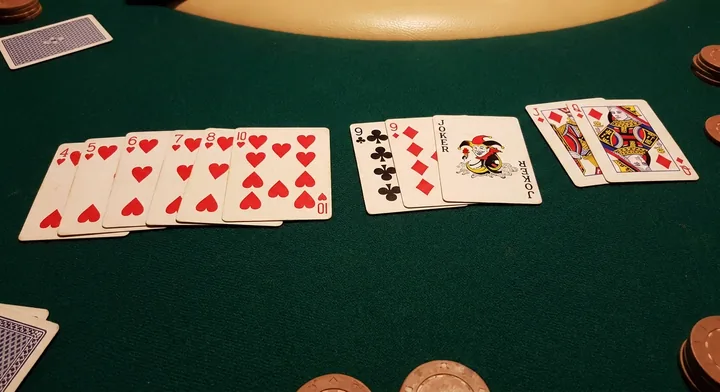
Goal
Arrange all thirteen of your cards into valid sequences and sets - Including at least one pure sequence and a second sequence - Then declare before your opponent does.
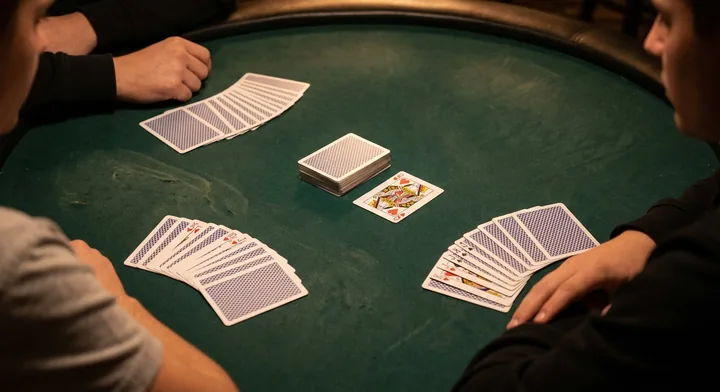
Deal
Two decks are combined with jokers and one card is cut to fix the wild-card joker for the round. Each player receives thirteen cards; the rest form the closed stock, with one card turned up to start the open discard pile.
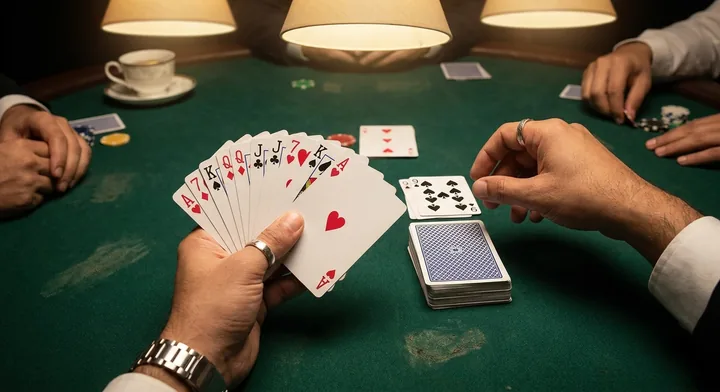
Draw and discard
On your turn, draw one card from either the closed stock or the top of the open discard pile, then discard one card face up. You always hold thirteen cards between turns.
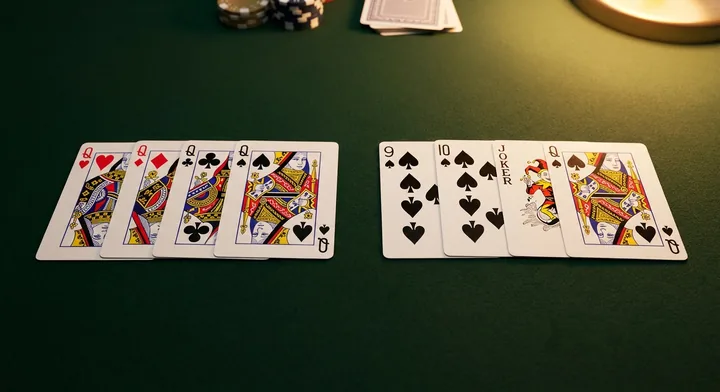
Melds
Build sequences (three or more consecutive cards of one suit) and sets (three or four cards of the same rank in different suits). The cut joker and printed jokers can stand in for any missing card, but a pure sequence must contain no joker at all.
Winning
Once your thirteen cards form valid groups with the required pure sequence, place your final card in the finish slot and declare. A correct declaration wins; a wrong one costs an 80-point penalty, and everyone else scores the pips of their unmatched cards.
History of Indian Rummy
Indian Rummy grew out of the worldwide rummy family, which traces back through games like Gin Rummy, Rummy 500, and the older Spanish-Mexican game Conquian. Somewhere along that lineage the thirteen-card, two-deck version took root in India, where it is also known as Paplu, and became one of the country's most beloved card games.
For generations the game has been a social ritual, dealt out at family reunions, weddings, and especially the festival of Diwali, where card play is a cherished tradition. Its blend of luck in the deal and skill in the melding gave it broad appeal across ages and regions, and house rules for drops and pool play spread from table to table.
The internet era transformed Indian Rummy from a parlor pastime into a massive online phenomenon. Real-money and free-to-play platforms standardized the rules - Two decks, the cut wild-card joker, the mandatory pure sequence, and the 80-point invalid-declaration penalty - And introduced points, pool, and deals formats that let millions play head-to-head at any hour.
How to Win Indian Rummy: Strategy
💡 Top tip: Build your pure sequence first - Nothing else in your hand counts until you have one run with no joker, so treat it as move number one.
Winning tips, in order of importance
- Hold the connectors that give a card two ways to complete a run; a 6 and 8 of hearts waiting on a 7 is far more flexible than a lone pair.
- Save jokers for high-value groups like sets of face cards, since a joker covering a King or Queen erases far more penalty pips than one covering a 3.
- Discard your highest unconnected cards early, because a stranded King or Ace left in hand at showdown costs a full ten points.
- Watch what your opponent picks from the open pile - It tells you which sequences and sets they are chasing so you can stop feeding them.
- Do not over-collect around a single rank; two decks make sets tempting, but sequences are easier to complete and safer to rely on.
- Keep a fallback second sequence forming even while you hunt sets, so a late joker can convert your hand into an instant valid declaration.
Advanced tactics for Indian Rummy
- Track the discard pile mentally: once both copies of a card you need have been thrown, abandon that group and re-route your hand toward cards still live in the stock.
- A middle card such as a 7 or 8 sits in more potential runs than an edge card, so when two discards look equal, release the one that blocks the fewest of your own future melds.
- Resist picking from the open pile unless the card completes or clearly advances a meld, since every open pick broadcasts your plan and forfeits the surprise of a closed draw.
- Plan for the wild-card joker's rank: because all four suits of that rank are wild, holding one early gives you a flexible filler you can slot into almost any set or off-suit run.
- When you are close, count your maximum penalty if you are caught short, and only declare when the pure-sequence requirement is locked - An invalid show at 80 points is worse than folding a weak hand.
- Against a fast opponent, consider dropping early if allowed in your rule set; conceding a small fixed penalty beats getting caught with a full hand of high cards at their declaration.
- Sequence your discards to bait: throwing a card adjacent to one you secretly need can tempt an opponent to release the very card that completes your run.
Common Indian Rummy mistakes to avoid
- Declaring without a pure sequence - a valid Indian Rummy show needs at least one run with no joker, and declaring without it can cost you a full-count penalty.
- Wasting your wild joker - the cut joker turns its whole rank into wilds, so use those cards to complete melds rather than discarding them.
- Chasing a second sequence before the first - lock in your pure run early, since without it the rest of your melds do not count.
- Discarding cards near the joker rank - you may be handing an opponent the exact wild they need, so track the joker rank before you toss.
Indian Rummy Variations
Points Rummy
The fastest format, played for a fixed point value per game. Each round is settled immediately, with the loser paying the winner based on their unmatched pip count multiplied by the agreed stake.
Pool Rummy
A knockout format where players accumulate points across many deals toward a ceiling of 101 or 201; reaching the ceiling eliminates you, and the last player standing wins the pool.
Deals Rummy
Played for a fixed number of deals with chips distributed at the start. Scores are tracked across the set number of hands, and the player with the most chips at the end takes the game.
First and middle drop
Many formats let a player fold before or during a hand for a fixed penalty - Commonly 20 points for a first drop and 40 for a middle drop - Letting you cut losses when your hand is hopeless.
21-card rummy
A bigger cousin dealt with three decks and twenty-one cards per player, adding extra jokers and special hands like tunnelas and dublees for a longer, more elaborate game.
Indian Rummy FAQ
What is a pure sequence in Indian Rummy?
A pure sequence is a run of three or more consecutive cards in the same suit that uses no joker or wild card at all, such as the 5, 6, and 7 of spades. You must have at least one pure sequence for your declaration to be valid, which makes it the single most important group to build. Without it, even a perfectly arranged hand is scored as a full loss.
How many decks and jokers does Indian Rummy use?
The standard game uses two full decks shuffled together along with the printed jokers. In addition, one card is cut at random at the start of each round to become the wild-card joker, and every card of that rank in all suits then acts as a joker for the hand.
What does it mean to declare?
Declaring is how you finish the game. When all thirteen of your cards are arranged into valid sequences and sets, you place your fourteenth drawn card into the finish slot face down and reveal your groups. If they are valid you win the round; if not, you are penalized.
How is scoring calculated?
The winner scores zero, and every other player adds up the pip value of the cards not in a valid meld. Face cards (Jack, Queen, King) and the Ace count as ten points each, while number cards score their face value. Depending on the rule set an Ace may instead count as one when used low in a sequence.
What happens if I declare incorrectly?
A wrong declaration - For example one missing a pure sequence or containing an invalid group - Is penalized 80 points, which is usually the maximum a hand can cost. Because the penalty is so steep, you should always double-check that your pure sequence is genuinely joker-free before you commit.
Can I use a joker in a pure sequence?
No. By definition a pure sequence contains only natural cards in suit order, so slipping a joker into it makes it an impure sequence instead. Jokers are perfectly legal in your second sequence and in your sets - Just never in the one run that satisfies the pure-sequence rule.
How many sequences do I need to win?
You need at least two sequences, and at least one of them must be pure. Once those two sequences are in place, the remaining cards may be completed as either additional sequences or as sets. This two-sequence requirement is what separates a legal declaration from an invalid one.
What is the difference between a set and a sequence?
A sequence, or run, is three or more consecutive cards of the same suit, like the 8, 9, and 10 of clubs. A set is three or four cards of the same rank in different suits, such as three Queens from different suits. Because two decks are in play, a valid set must not repeat the same suit twice.
Indian Rummy guides & strategy
Still have a question about Indian Rummy? Browse the full rummy FAQ, look up a term like meld or deadwood in the rummy glossary, or compare Indian Rummy with the other games in the rules for every rummy game.
Last updated .