Play Straight Gin
No knocking allowed - You must go Gin to take the hand.How to Play Straight Gin
In a nutshell: No knocking allowed - You must go Gin to take the hand. You play 2 players against the computer with 1 deck and 10 cards each, it's rated pure skill, and the goal is simple: meld all ten cards with no deadwood; knocking is not allowed, so only a full gin wins the hand.
Straight Gin strips Gin Rummy back to its purest, most demanding form by removing the safety valve of knocking altogether. In the standard game you can bail out early by knocking with ten or fewer deadwood points, but here that door is locked - the only way to win a hand is to meld all ten of your cards and go Gin. Every card must find a home in a set or a run, with not a single point of deadwood left over. That one restriction transforms the feel of the game completely: there is no settling for a small, safe finish, so both players must build patiently, read the discard pile carefully and hold their nerve as the stock shrinks. Straight Gin is prized by serious players precisely because luck matters less and pure card sense matters more - it is Gin distilled to its hardest, cleanest challenge.
Straight Gin at a glance
| Goal | Meld all ten cards with no deadwood; knocking is not allowed, so only a full Gin wins the hand. |
|---|---|
| Players | 2 players (versus the computer here) |
| Cards dealt | 10 cards each |
| Decks used | 1 standard deck |
| Difficulty | Pure skill |
| Family | Gin Family |
Step by step
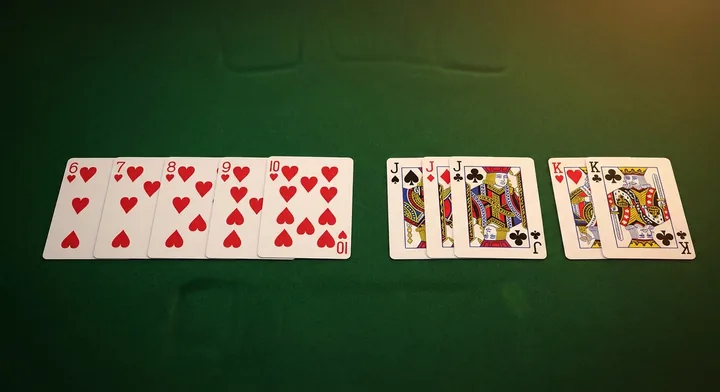
Goal
Meld every one of your ten cards into sets and runs and go Gin - knocking is not allowed, so a hand can only be won with a complete, deadwood-free arrangement.
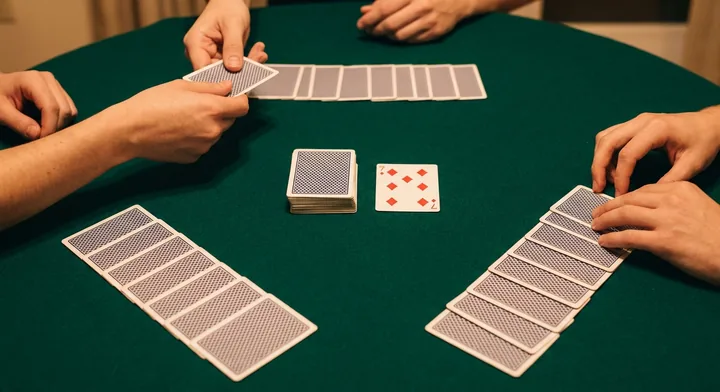
Deal
Use a single 52-card deck and deal ten cards to each of the two players. Turn the next card face up to start the discard pile, and the rest of the deck forms the face-down stock.
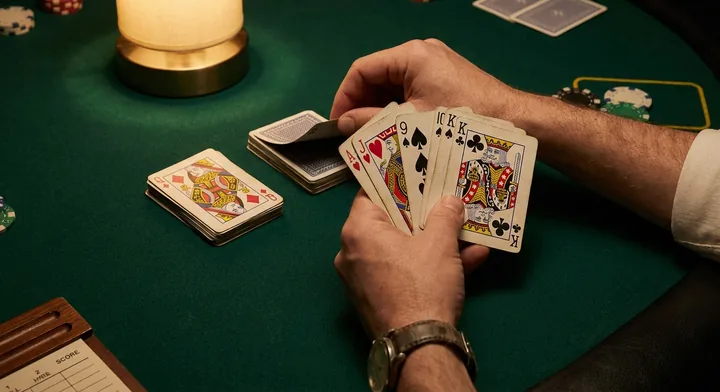
Draw and discard
On your turn draw one card from the stock or the top of the discard pile, then discard one card, keeping ten cards in hand. Play continues back and forth until someone goes Gin.
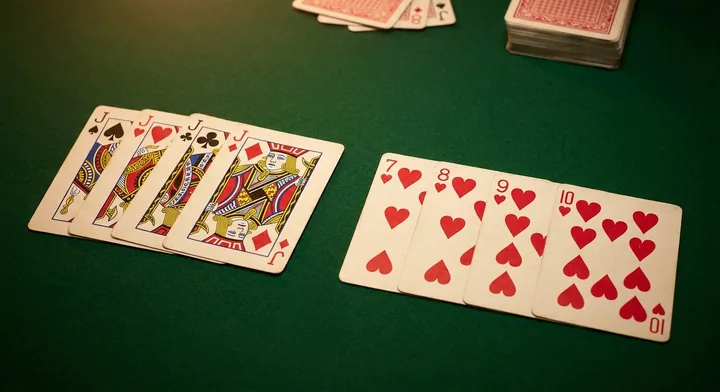
Melds
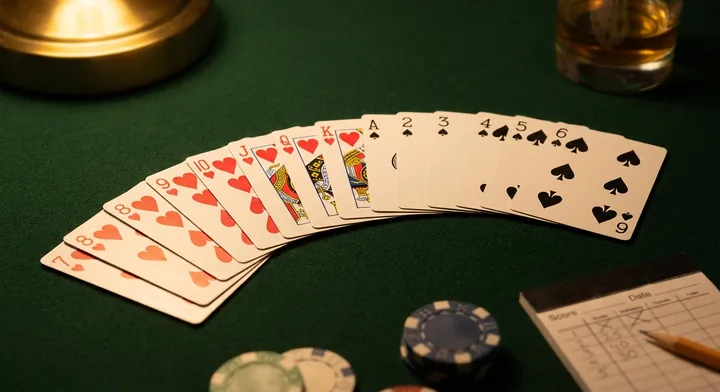
Build sets of three or four cards of the same rank and runs of three or more consecutive cards in one suit. Aces are low and runs do not wrap. To win you must arrange all ten cards into valid melds with no card left over.
Winning
The hand ends only when a player goes Gin by melding all ten cards. The winner scores the opponent's full deadwood count plus the standard Gin bonus. If the stock runs out before anyone goes Gin, the hand is usually a draw and is redealt.
History of Straight Gin
Straight Gin is a stripped-down relative of Gin Rummy, the immensely popular two-player game credited to Elwood T. Baker of New York around 1909. Where Baker's game introduced the knock as a way to end a hand short of a perfect meld, Straight Gin removes that shortcut entirely, returning play to the older Rummy ideal of melding your whole hand before you can go out.
The variant grew up alongside standard Gin during its mid-twentieth-century heyday, when the game swept through American card clubs and Hollywood studios. Players looking for a sterner test found that banning the knock changed the texture of every hand: the small, safe finishes disappeared, and success came to depend far more on skillful hand-building and reading an opponent than on grabbing an early, modest lead.
Today Straight Gin endures as the connoisseur's version of Gin, offered in card compendiums and digital collections as the option for players who want less luck and more craft. By insisting on a full Gin every single hand, it distills the family's core appeal - patient melding, careful discarding and the tense race to complete a hand - into its purest and most challenging form.
How to Win Straight Gin: Strategy
💡 Top tip: Because only Gin wins, plan your hand around flexibility - keep cards that can slot into more than one meld so you always have a path to that final, complete arrangement.
Winning tips, in order of importance
- Never chase a card that has already been discarded twice or more - with no knocking to fall back on, a dead rank can strand your whole hand, so pivot to live melds early.
- Draw from the discard pile only when the card clearly advances a meld, since every pickup tells your opponent exactly which suits and ranks you are collecting.
- Watch the stock count closely - if the deck is running low and you are far from Gin, shift to blocking your opponent's obvious melds to force a redeal rather than a loss.
- Hold onto middle-rank connectors that bridge potential runs, because they give you the widest choice of completing sequences on your way to a full hand.
- Discard the cards least likely to help you complete a meld first, keeping your hand's completion routes open for as long as possible.
- Since deadwood only matters at the very end, do not agonize over point values early - focus entirely on which combinations can actually reach a clean, ten-card meld.
Advanced tactics for Straight Gin
- Map every card your opponent picks from the discard pile - in Straight Gin the whole game is a slow race to Gin, so denying them one key card can stall their hand until the stock dies.
- Keep at least two independent meld plans alive at once, so that if your opponent snatches or buries a card you need, you can fall back on the alternative without your hand collapsing.
- As the stock thins, count which of your needed cards remain unseen; if the odds of completing your last meld vanish, switch fully to a spoiling game aimed at a draw.
- Prefer holding a pair that can grow into either a set or a run over a rigid partial run, because in a knock-free game your final card is usually the hardest one to land.
- Feed your opponent only truly dead cards - ranks and suits that can no longer form runs or sets - since a single loose discard can be the exact card that hands them Gin.
- Because there is no undercut or small knock to manage, all your reading energy goes into two questions: what does the opponent need, and can I get there first.
- When the deck approaches empty and neither hand is close, treat the last few discards defensively - forcing a redeal preserves the score far better than gifting the win.
Common Straight Gin mistakes to avoid
- Trying to knock with deadwood - straight gin has no knocking, so you must meld your entire hand before you can go out.
- Discarding cards your opponent clearly wants - with no early knock to end things, feeding their melds just hands them the win.
- Holding a fourth card that duplicates a set - it rarely extends anything, so release it and chase a card that completes a real run.
- Drawing from the stock on autopilot - since only a full gin ends the hand, weigh every discard-pile card that could finish a meld first.
Straight Gin Variations
Standard Gin Rummy
The parent game, which restores the knock so you can end a hand with ten or fewer deadwood points instead of being forced to go Gin every time.
Oklahoma Gin
A cousin that keeps knocking but lets the first upcard set the knock limit, occasionally squeezing all the way down to a mandatory Gin when the upcard is an ace.
Big Gin
A bonus rule sometimes layered onto Straight Gin that awards extra points, often 31, for going Gin with all eleven cards melded and without discarding your last card.
Straight Gin to 150 or 250
Longer sessions raise the target score above the usual 100, stretching out the match and giving the better card player more room to pull ahead.
Round the Corner Straight Gin
A twist that allows runs to wrap around King-Ace-2, expanding the possible melds while keeping the no-knock, Gin-only requirement intact.
Straight Gin FAQ
What makes Straight Gin different from regular Gin Rummy?
In Straight Gin you cannot knock at all. Where standard Gin lets you end a hand with ten or fewer deadwood points, Straight Gin only allows a win by going Gin - melding all ten of your cards with zero deadwood. This makes it the most demanding form of the game.
Can you knock in Straight Gin?
No. Knocking is completely disallowed, which is the whole point of the variant. The only way to end a hand and score is to arrange every one of your ten cards into valid sets and runs and declare Gin.
What happens if the stock runs out in Straight Gin?
If the draw pile is exhausted before either player goes Gin, the hand is normally declared a draw and the cards are reshuffled and redealt. Some groups use the last discard as a signal to end, but a no-score redeal is the most common outcome.
How do you score Straight Gin?
When a player goes Gin, they add up the opponent's entire hand as deadwood and score that total plus the Gin bonus, usually 25 points. Because every hand must be a full Gin, there are no partial knocks or undercuts to complicate the scoring.
Is Straight Gin harder than standard Gin?
Yes, considerably. Removing the knock takes away the safe, early exit that standard Gin offers, so you must build a flawless ten-card hand every time. It rewards patience and card reading over quick, opportunistic finishes, which is why skilled players enjoy it.
Do the same melds count in Straight Gin?
Yes. Sets of three or four cards of the same rank and runs of three or more consecutive cards in one suit are the only valid melds, exactly as in ordinary Gin. Aces stay low and runs do not wrap around from King to Ace.
Can your opponent lay off cards in Straight Gin?
There is nothing to lay off onto, because the game is only ever won by a complete Gin and the losing hand is scored in full as deadwood. Lay-offs exist in standard Gin to reduce your count against a knock, and Straight Gin has no knocks.
What score do you play to in Straight Gin?
As with other Gin games, 100 points is the usual target across a series of hands, with the customary game and line bonuses. Since every completed hand is a full Gin, individual hand scores tend to be larger and more decisive.
Straight Gin guides & strategy
Still have a question about Straight Gin? Browse the full rummy FAQ, look up a term like meld or deadwood in the rummy glossary, or compare Straight Gin with the other games in the rules for every rummy game.
Last updated .