Play Classic Rummy
The original draw-and-discard game - Meld every card to go out.How to Play Rummy
In a nutshell: The original draw-and-discard game - Meld every card to go out. You play 2 players against the computer with 1 deck and 10 cards each, it's rated easy to learn, and the goal is simple: meld all of your cards into sets and runs and discard your last card to go out before your opponent.
Rummy is the original draw-and-discard card game, the simple, elegant ancestor that every other game in the family grew from. Using a single 52-card deck, two players each take ten cards and race to organize their hand into melds - sets of three or four cards of the same rank, and runs of three or more consecutive cards in one suit. On your turn you draw a single card from the stock or the top of the discard pile, try to build or extend melds, then throw one card away. The first player to meld every card and discard their last one goes out and wins the deal. What makes Rummy so enduring is its balance of luck and skill: the deal is random, but reading discards, holding useful cards, and timing your exit reward a sharp, patient mind at every table.
Rummy at a glance
| Goal | Meld all of your cards into sets and runs and discard your last card to go out before your opponent. |
|---|---|
| Players | 2 players (versus the computer here) |
| Cards dealt | 10 cards each |
| Decks used | 1 standard deck |
| Difficulty | Easy to learn |
| Family | Classic Rummy |
Step by step
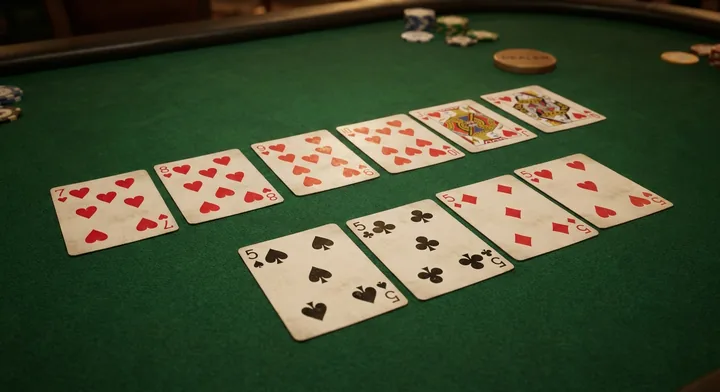
Goal
Be the first to arrange your whole hand into valid melds - sets and runs - and discard your final card to go out. Sets are three or four cards of the same rank; runs are three or more consecutive cards in a single suit, such as 5-6-7 of hearts.
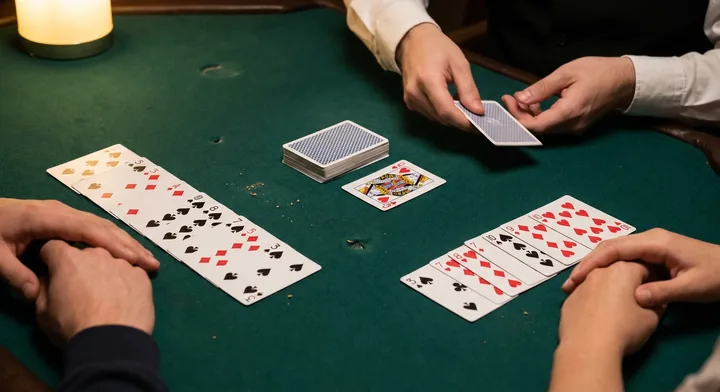
Deal
Shuffle one standard 52-card deck. Each of the two players receives ten cards. The rest form the stock, placed face down, and the top card is turned up beside it to start the discard pile.
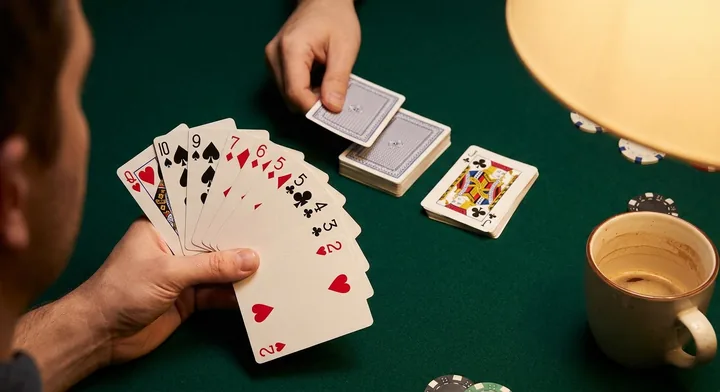
Draw and discard
Begin every turn by drawing exactly one card, either the unknown top card of the stock or the visible top card of the discard pile. End the turn by placing one unwanted card face up on the discard pile, keeping your hand at ten cards.
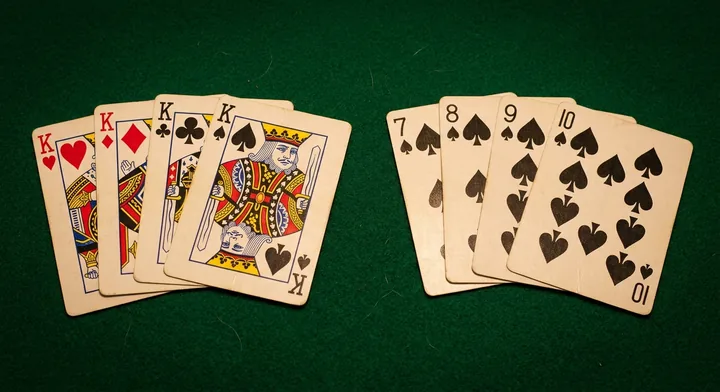
Melds
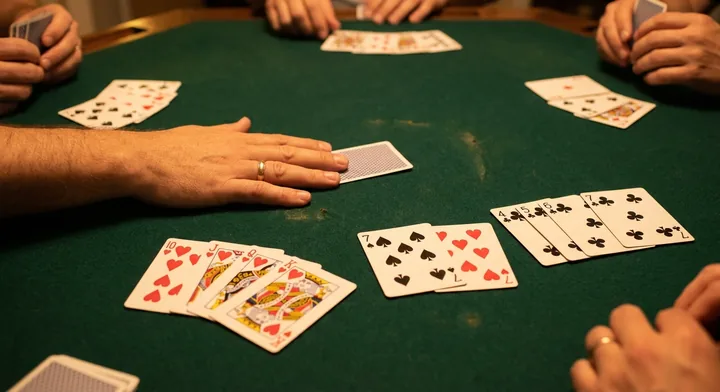
Between drawing and discarding you may lay down any valid sets or runs face up on the table, and lay off extra cards onto melds already showing - yours or, in the common house rule, your opponent's - to shed cards faster.
Winning
The moment you have melded all your cards and discarded your last one, you go out and win the deal. Your opponent counts the pip value of the unmelded cards still in hand as penalty points against them.
History of Rummy
Rummy belongs to one of the largest families in all of card gaming, and its roots are tangled across several continents. Many historians trace it to Conquian, a two-player melding game played in Mexico and the American Southwest in the nineteenth century, which itself may descend from the Spanish game Conquian. Others point east to the Chinese draw-and-discard games Khanhoo and Mahjong, whose melding of sets and runs closely mirrors Rummy's core idea.
By the early twentieth century the game had settled into the form recognizable today and swept through the United States under the name Rum or Rummy, supposedly linked to the drink a loser had to buy. Its simplicity made it a household staple through the 1900s, easy enough for children yet deep enough to hold adults' attention across countless evenings and rainy afternoons.
From that single, straightforward parent sprang a huge lineage - Gin Rummy, Rummy 500, Canasta, Kalooki, and Indian Rummy among them - each adding scoring twists, wild cards, or new melding rules. The plain version described here, sometimes called Straight Rummy or Sant Rummy, remains the clearest window into what makes the whole family tick.
How to Win Rummy: Strategy
💡 Top tip: Watch the discard pile closely - the cards your opponent throws and picks up tell you which suits and ranks are safe to release and which to hoard.
Winning tips, in order of importance
- Favor runs over sets early, because a run can grow at both ends and accepts more future draws than a rank-locked set.
- Keep middle cards like 6, 7 and 8 longer than edge cards; they connect to more possible runs and sets.
- Do not rush to lay down every meld - holding cards back keeps your plan hidden and preserves your lay-off options.
- Track how many cards your opponent holds; when they are close to going out, dump high pips fast to cut your losses.
- Avoid picking from the discard pile unless the card completes or clearly advances a meld, since taking it reveals your intentions.
- Balance your hand between two developing melds so a single unlucky draw does not strand you with a stalled plan.
Advanced tactics for Rummy
- Count the deck: once a rank or a key connector has been discarded, abandon melds that depend on the missing copies and pivot early.
- Use the discard pile as a weapon - throwing a card adjacent to what you discarded before can bait an opponent into a false read of your hand.
- When the stock runs thin, shift from building the perfect hand to simply minimizing deadwood, so a forced reshuffle or an opponent's exit costs you little.
- Delay laying off onto your opponent's melds until you are ready to go out, so you do not gift them information about your remaining cards.
- If you are collecting a set, prefer the two suits your opponent seems to be ignoring, so the third card is more likely to reach the stock for you.
- When defending a losing position, keep low-pip cards in hand and discard the high ones, so being caught at the end slashes your penalty.
- Recognize a dead hand early - if two independent melds refuse to complete, break one and rebuild rather than clinging to a hopeless plan.
Common Rummy mistakes to avoid
- Melding as soon as you legally can - laying down early exposes your plan and dumps cards your opponents can lay off onto.
- Keeping high cards too long - if you get caught holding them when someone goes out, face cards and Aces pile up penalty points.
- Ignoring the discard pile - watching what others take and toss reveals their melds so you can stop feeding them.
- Forgetting to lay off onto existing melds - adding your loose cards to melds already on the table clears deadwood before the round ends.
Rummy Variations
Straight Rummy
The purest form, in which no melds may be laid down until a player can put their entire hand down at once, rewarding patient hand-building over gradual melding.
Block Rummy
When the stock is used up, play simply ends instead of reshuffling the discard pile; everyone still holding cards scores their deadwood, which speeds the game up.
Round the Corner
A house rule that lets the ace connect king and two, so runs like K-A-2 become legal and the ace can count high or low as the run requires.
Boathouse Rummy
A two-player twist where a player who takes the discard must then also draw a second card but still discards only one, adding tension to every pickup.
Multi-player Rummy
With three to six players the hand size usually shrinks, often to seven cards, so more people can share the single deck while the draw, meld, and discard rhythm stays identical.
Rummy FAQ
How many cards make a valid meld?
A meld needs at least three cards. A set is three or four cards of the same rank in different suits; a run is three or more cards in consecutive order within a single suit, such as 5-6-7 of hearts.
Can the ace be high and low at the same time?
No. In basic Rummy the ace is low, forming runs like A-2-3. It does not wrap around from king back to ace, so Q-K-A is not a valid run unless a house rule specifically allows a high ace.
What is deadwood?
Deadwood is any card left in your hand that is not part of a completed meld when the deal ends. Each deadwood card scores its pip value as penalty points against the player still holding it.
Do I have to discard on every turn?
Yes. Every turn ends with one card placed on the discard pile, which keeps your hand at ten cards. You draw, optionally meld or lay off, then discard, so the size of your hand stays constant until you go out.
What is laying off?
Laying off means adding a card from your hand to a meld already on the table - for example placing the 8 of clubs onto an existing 5-6-7 of clubs run - so you unload cards without having to start a brand new meld.
What happens if the stock runs out?
If the stock is exhausted before anyone goes out, the discard pile except its top card is shuffled to form a fresh stock and play continues. Some players instead end the deal on the spot and score the deadwood.
How do you actually win?
You win a deal by melding every card in your hand and discarding your last card, which is called going out. Over a full game you win by holding the fewest penalty points when someone reaches the agreed target score.
Is Rummy a game of luck or skill?
Both. The deal is random, but skilled players win consistently through careful card counting, reading discards, smart melding order, and knowing when to go out versus when to keep improving the hand.
Rummy guides & strategy
Still have a question about Rummy? Browse the full rummy FAQ, look up a term like meld or deadwood in the rummy glossary, or compare Rummy with the other games in the rules for every rummy game.
Last updated .