How to Play Rummy 500
In a nutshell: Lay off, score your melds, and race to 500 points. You play 2 players against the computer with 1 deck and 7 cards each, it's rated moderate, and the goal is simple: score points for every card you meld or lay off across many hands; the first player to 500 wins.
Rummy 500, also called 500 Rum, turns the classic draw-and-discard game into a running points race that stretches across many hands. Two players start with seven cards each, but the twist that defines the game lives in the discard pile: instead of taking only the top card, you may scoop up a whole stack of discards down to any card you want - as long as you immediately meld that buried card. Every card you meld or lay off scores its face value in your favor, while cards trapped in your hand at the end of a deal are subtracted from your total. Hands add up, deal after deal, until one player crosses 500 points and wins. Choose Ace Low, where the ace ranks below the two and scores a single point, or Ace High, where the ace tops runs and is worth a hefty fifteen - a choice that reshapes how you value every ace.
Rummy 500 at a glance
| Goal | Score points for every card you meld or lay off across many hands; the first player to 500 wins. |
|---|---|
| Players | 2 players (versus the computer here) |
| Cards dealt | 7 cards each |
| Decks used | 1 standard deck |
| Difficulty | Moderate |
| Play modes | Ace Low, Ace High |
| Family | Classic Rummy |
Step by step

Goal
Score more points than your opponent by melding and laying off cards across many deals, being the first to reach a cumulative total of 500 points. Melded cards earn their value; cards left in hand are subtracted from your score.

Deal
Shuffle one standard 52-card deck and deal seven cards to each of the two players. Place the remaining cards face down as the stock and turn the top card face up to begin the discard pile, which is spread out so every discard stays visible.

Draw and discard
Start your turn by drawing the top stock card, or by taking one or more cards from the discard pile down to any card you choose - provided you immediately meld or lay off that lowest card you took. Finish the turn by discarding one card face up.
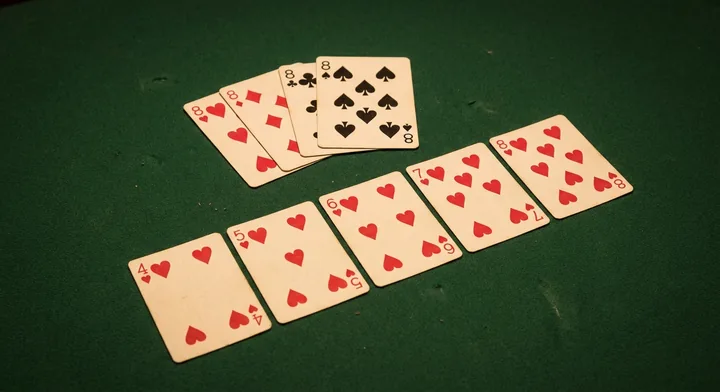
Melds
Lay sets of three or four matching ranks and runs of three or more cards in one suit. In Ace Low mode the ace ranks below the two and anchors runs like A-2-3; in Ace High mode it ranks above the king and tops runs like Q-K-A. Lay off onto any meld on the table, including your opponent's, since a card scores for whoever plays it.

Winning
A deal ends when a player melds out or the stock is exhausted. Face cards and tens score 10, number cards score their pip value, and the ace scores 1 in Ace Low or 15 in Ace High; add your melds and subtract your hand. First to 500 across deals wins.
History of Rummy 500
Rummy 500 emerged in the United States in the early twentieth century as one of the most popular offshoots of the basic Rummy game that was sweeping the country. By adding a cumulative points target and, crucially, the right to rake multiple cards from the discard pile, it transformed a quick knock-about game into a strategic contest that could hold a table for an entire evening.
The multiple-discard rule was the innovation that set 500 Rum apart from its parent. Suddenly the growing pile of thrown-away cards was not garbage but a resource, and players had to weigh the value of a buried gem against the burden of the cards stacked on top of it. That single change deepened the game enormously and made memory and planning as important as the luck of the deal.
Rummy 500 went on to become a fixture of American family card play and a standard entry in twentieth-century card-game compendiums. It also served as a bridge toward richer relatives like Canasta, which took the ideas of large melds and pile-capturing even further, cementing 500 Rum's place as a key rung on the Rummy family ladder.
How to Win Rummy 500: Strategy
💡 Top tip: Master the discard pile - the power to reach deep and grab a buried card you can meld is the single biggest edge in Rummy 500, so plan your pickups around it.
Winning tips, in order of importance
- Do not fear taking several discards at once; if the buried card completes a meld and the extras give you future lay-offs, the points swing hard in your favor.
- Because melded cards score for the player who lays them, lay off aggressively onto your opponent's melds to bank easy points.
- Hold high cards only when a meld is close; a king or queen caught in your hand costs you ten points each when the deal ends.
- In Ace High mode an ace is worth fifteen points, so melding one is lucrative but being caught with it is brutal - handle aces with extra care.
- Keep your own melds spread and visible so you never lose track of lay-off spots, and note every meld your opponent lays for the same reason.
- Since the game is a marathon to 500, weigh each deal's risk against your running score rather than chasing one big hand.
Advanced tactics for Rummy 500
- Memorize the order of the discard pile; knowing exactly which cards sit above a target lets you calculate whether a deep grab leaves you overloaded with deadwood.
- Deny your opponent by discarding cards that sit safely on your own future melds rather than ones that feed their obvious collections.
- In Ace Low mode low cards are cheap to be caught with, so use them as safe late-game discards while you hoard the high scorers to meld.
- In Ace High mode flip that logic - unload high cards early when in doubt, because a stranded ace or face card can erase a whole deal's gains.
- Time your going-out to strand your opponent with a full hand; catching them holding several high cards can be worth more than the melds you complete.
- Track the running score to set your tempo: when comfortably ahead, meld conservatively and go out fast; when behind, take bigger pile-diving risks to close the gap.
- Watch which suits your opponent takes from the discard pile and starve those runs by holding the connecting cards, even at a small deadwood cost.
Common Rummy 500 mistakes to avoid
- Forgetting Aces count fifteen when played high - an Ace stuck in your hand at the end is fifteen penalty points, so meld or drop it deliberately.
- Ignoring the whole discard pile - in Rummy 500 you may take multiple cards from it, so grab a buried card when it completes a meld and you can use the ones above it.
- Racing to go out first - since you score the points you meld, laying down lots of value can beat ending the hand quickly with little on the table.
- Leaving melded cards unextended - lay off onto your own and others' melds to bank more points before the round closes.
Rummy 500 Variations
Persian Rummy
A close cousin played to 500 with jokers added as wild cards and four fixed rounds, rewarding sets of four with bonus points and giving the game a livelier, higher-scoring feel.
Alternate targets
Some groups race to 250 for a quicker game or push all the way to 1000 for a longer session, with every other rule left completely unchanged.
Multi-player 500 Rum
With three to eight players the deal often drops to seven cards and a second deck is added, but the signature multiple-discard pickup and cumulative scoring stay exactly the same.
Discard freeze
A house rule that lets a player 'freeze' the discard pile so no one may dig below the top card until a natural meld thaws it, adding a defensive lever to the game.
Reshuffle ending
A variant that, when the stock empties, keeps play going by reshuffling the discards into a fresh stock, so deals only end on a player melding out rather than on a dead stock.
Rummy 500 FAQ
How is Rummy 500 different from basic Rummy?
The two big differences are scoring and the discard pile. You play to a cumulative 500 points rather than emptying your hand once, and you may take several cards from the discard pile at once instead of only the top card, as long as you meld the deepest card you take.
What is the difference between Ace Low and Ace High mode?
In Ace Low mode the ace ranks below the two, forms runs like A-2-3, and scores just one point. In Ace High mode the ace ranks above the king, tops runs like Q-K-A, and scores fifteen points, making aces far more valuable and riskier to hold.
How do cards score?
Face cards and tens are worth 10 points, number cards score their printed value, and the ace scores 1 in Ace Low or 15 in Ace High. You add the value of the cards you melded and subtract the value of the cards still in your hand when the deal ends.
Can I really take more than one card from the discard pile?
Yes, and it is central to the game. You may take a stack of discards from the top down to any card you like, but you must immediately meld or lay off that lowest card you took; the cards above it join your hand.
Why would I lay off on my opponent's melds?
Because points go to whoever plays the card, not whoever started the meld. Laying off onto an opponent's run or set banks those points for you, so it is almost always worth doing when you hold a fitting card.
When does a deal end?
A deal ends the instant one player melds and discards their whole hand, or when the stock runs out and neither player can or wishes to continue. Both players then tally their melds minus the cards still in their hands.
What happens when the stock is empty?
If the stock runs dry before anyone goes out, the deal ends where it stands. Players score the cards they have melded and subtract whatever remains in hand, then a new deal is dealt if no one has yet reached 500.
How long does a full game take?
Because 500 points usually needs several deals, a game runs longer than a single hand of basic Rummy - often twenty minutes to well over half an hour, depending on how boldly both players meld and how much the ace value inflates scores.
Rummy 500 guides & strategy
Still have a question about Rummy 500? Browse the full rummy FAQ, look up a term like meld or deadwood in the rummy glossary, or compare Rummy 500 with the other games in the rules for every rummy game.
Last updated .